Launch sale · this guide $9.99 · was $20 · save 50%
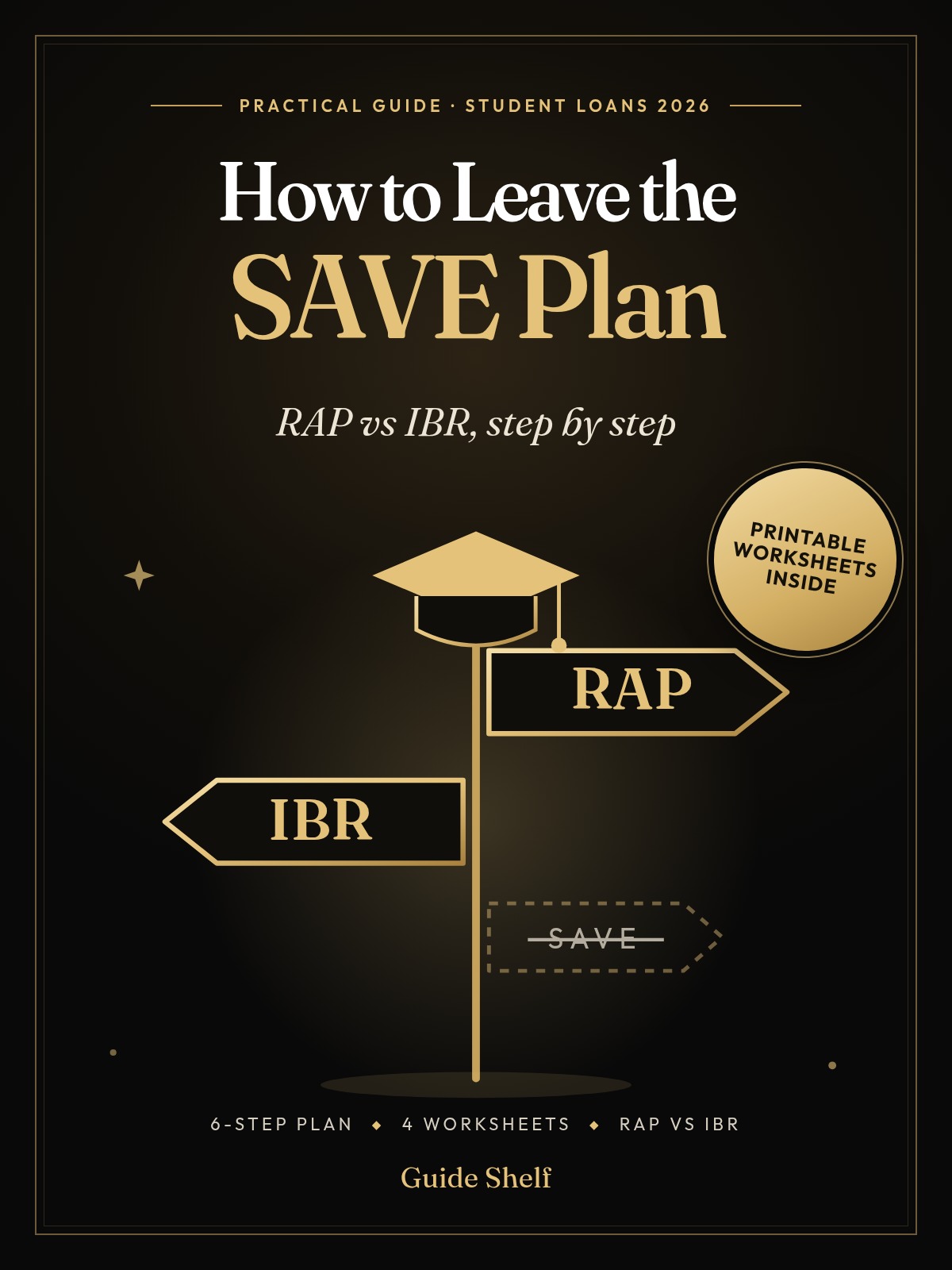
−50%Cover of the guide How to Leave the SAVE Plan, RAP vs IBR step by step, with a printable worksheets badge
Student loans · Printable PDF · SAVE exit, fall 2026

How to Leave the SAVE Student Loan Plan

SAVE is over, and your servicer will pick a plan for you if you don't. Find your real deadline, run the RAP and IBR math with your own income, and apply. The free answer is below; the 15-page guide has the worksheets.

$20$9.99
Get instant access — $9.99

Instant download after checkout. Secure payment by Stripe.

  • 15-page PDF, US Letter, prints well in black and white
  • 4 fill-in worksheets, including RAP and IBR payment estimates
  • Rules checked October 7, 2026, with sources

How to leave the SAVE plan: the short answer

A court order ended the SAVE plan on March 10, 2026. Servicers have been sending notices in waves since July 1, and you have 90 days from the date on your notice to choose a new plan. If you don't, you'll be placed in the Standard or Tiered Standard plan, depending on your loan dates (MOHELA SAVE FAQ). Some first-wave borrowers have received a 30-day final notice.

1. Find the date on your notice

Count 90 days from it. That is your deadline, not a date you saw in the news. Aim to apply two weeks early.

2. List your loans and their dates

Log in at StudentAid.gov and note each loan's type, balance, rate, and first disbursement date. A new loan or consolidation on or after July 1, 2026 limits you to RAP or Tiered Standard. Parent PLUS loans can't use RAP.

3. Estimate your RAP payment

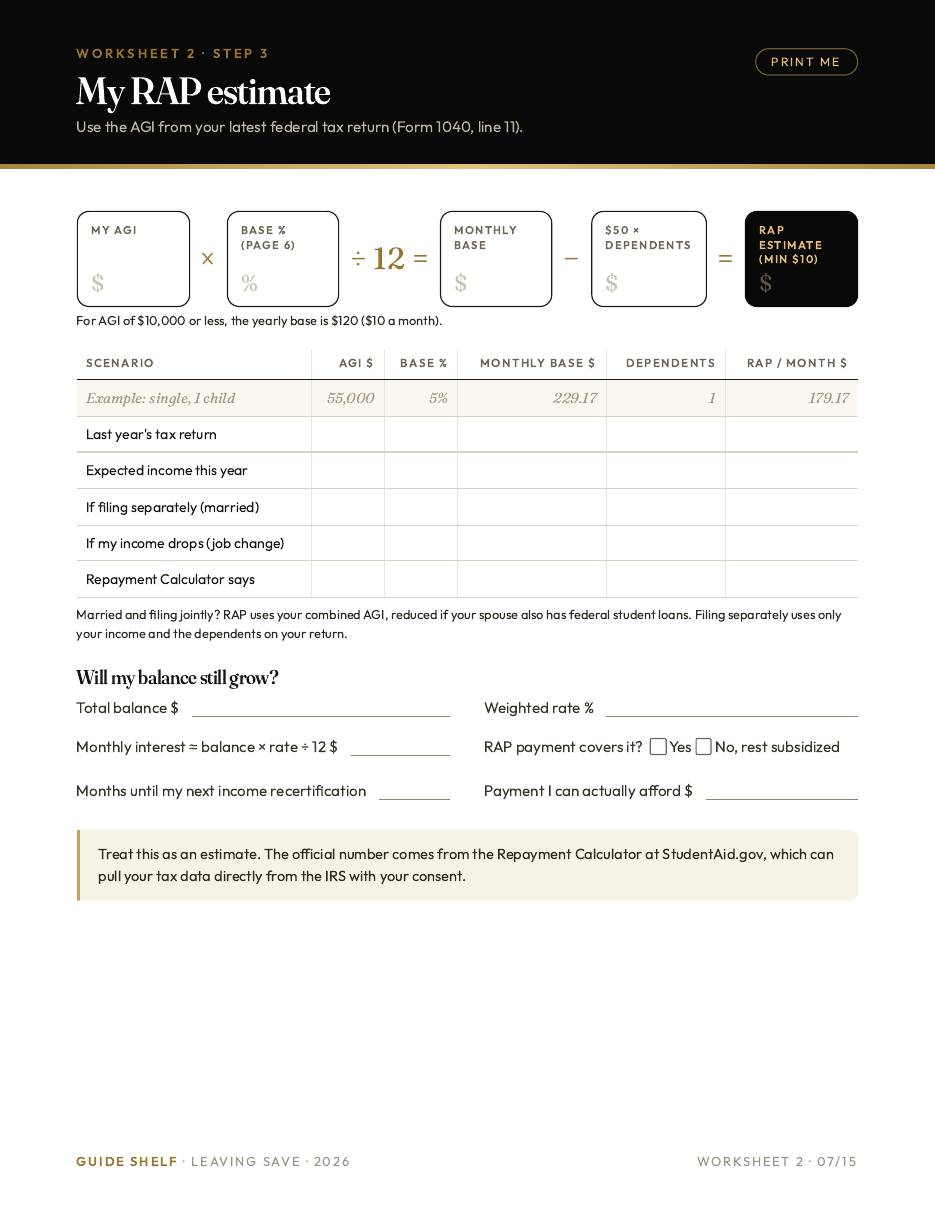
RAP per month = AGI × base % (1% to 10%) ÷ 12 − $50 per dependent, minimum $10

At $55,000 of adjusted gross income, the base is 5%: about $229 a month, or $179 with one dependent (our math from the servicer's RAP table). If your payment doesn't cover the month's interest, the rest is subsidized. Forgiveness comes after 30 years.

4. Estimate your IBR payment

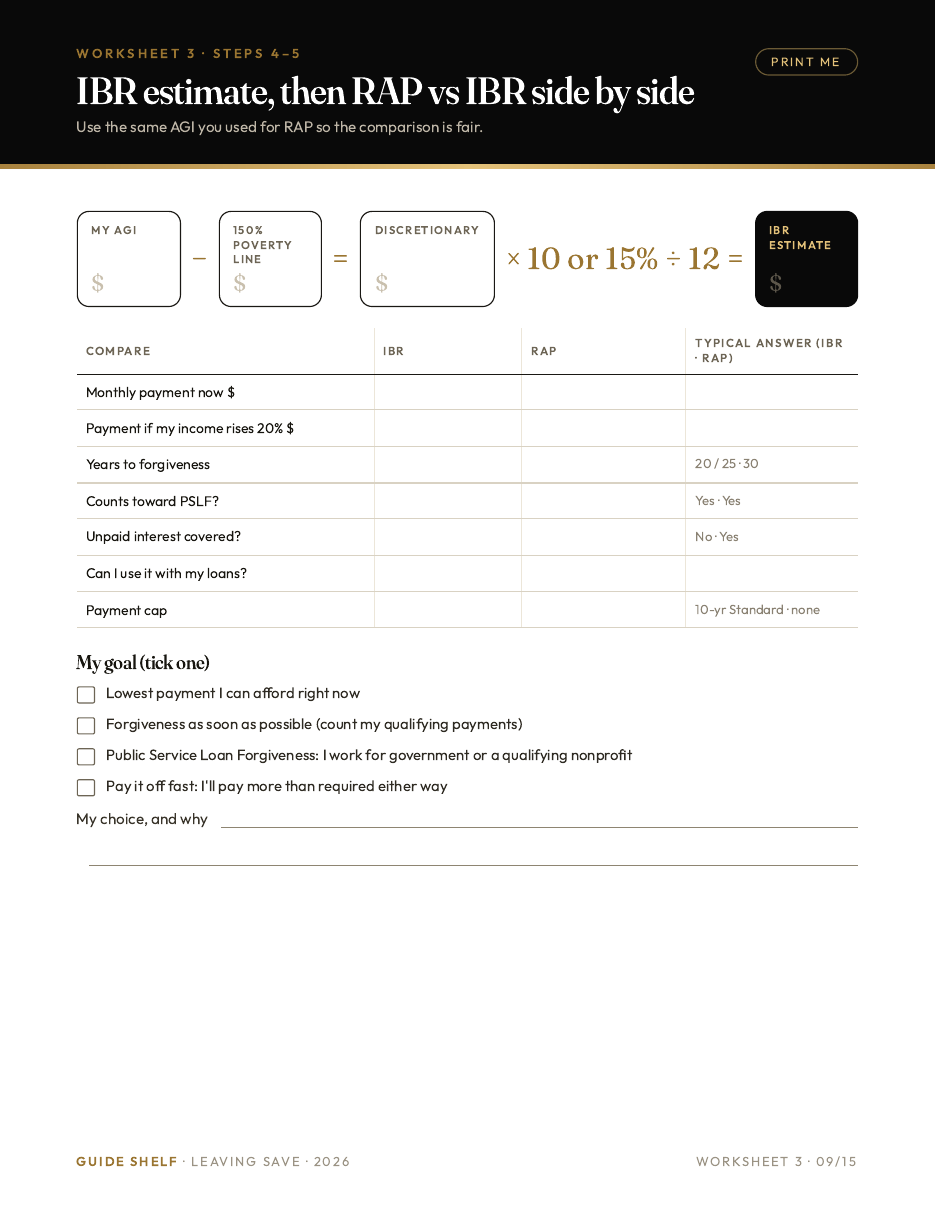
IBR per month = (AGI − 150% of the poverty guideline) × 10% or 15% ÷ 12

10% with 20-year forgiveness if you first borrowed on or after July 1, 2014; 15% and 25 years if earlier. For one person in the 48 states, 150% of the 2026 guideline is $23,940, so $55,000 of AGI gives about $259 a month at 10% (our math).

5. Choose for your goal

Lowest payment now, fastest forgiveness, or Public Service Loan Forgiveness. IBR and RAP can both count toward PSLF; Tiered Standard does not. Income-driven forgiveness granted on or after Jan 1, 2026 is generally taxable; PSLF is not.

6. Apply on StudentAid.gov, then confirm

Use the Repayment Calculator, give consent to pull your tax data, pick your plan, and save the confirmation. Then check that your servicer shows the new plan and payment. Enroll in autopay by Dec 31, 2026 for the temporary 1% rate cut. Changing plans is free; never pay anyone to do it.

General education, not legal, tax, or financial advice. We are not affiliated with the Department of Education or any servicer. Rules checked October 7, 2026; your own notices and StudentAid.gov are the final word.
Look inside

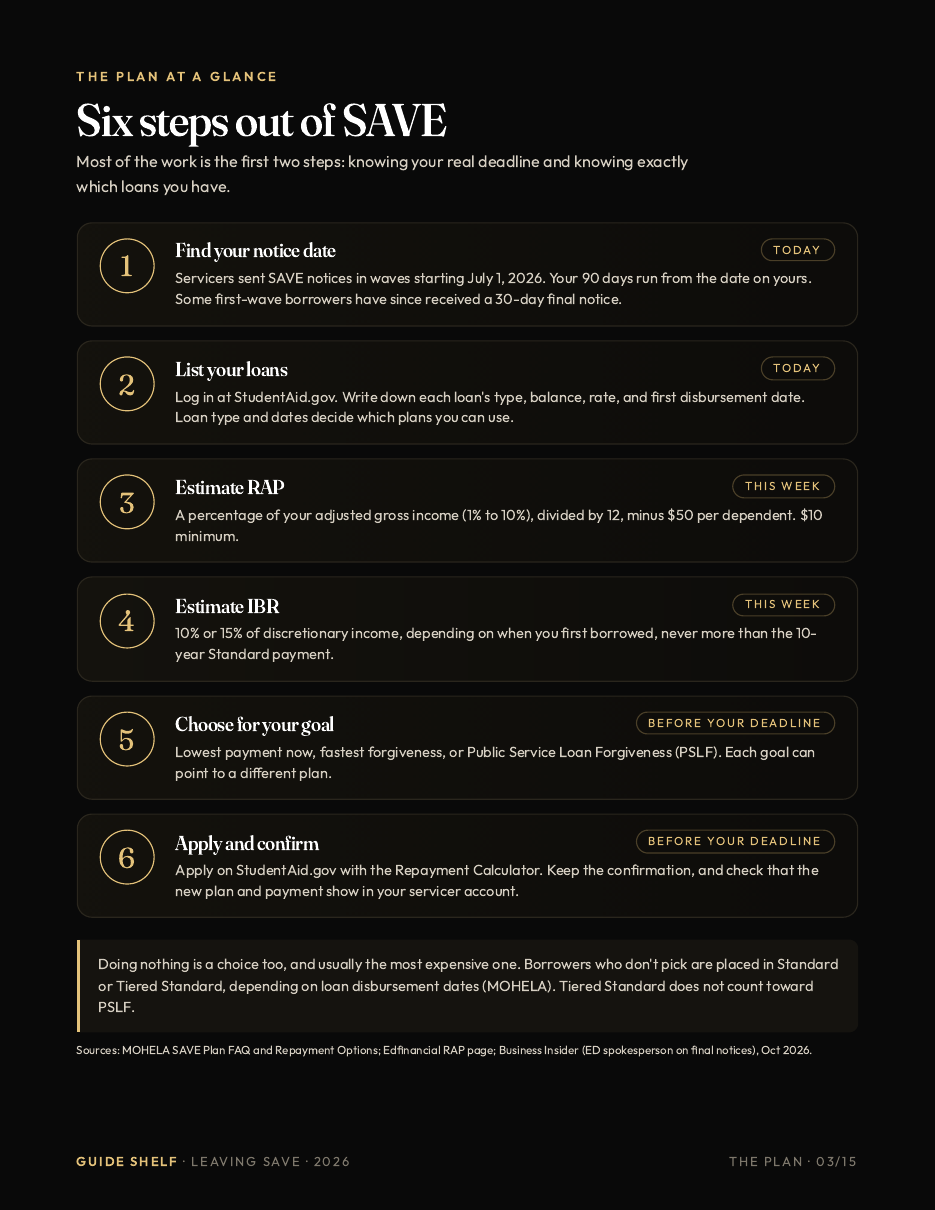
Guide page: the six-step plan for leaving the SAVE plan
The six-step plan out of SAVE
Printable worksheet: estimate your RAP payment from your AGI and dependents
Worksheet 2 · My RAP estimate
Printable worksheet: IBR estimate and RAP vs IBR side by side
Worksheet 3 · IBR estimate and comparison

What's inside

  • The six-step plan: from your notice date to a confirmed new plan
  • What changed, and when: Dec 2025 to July 2028, plus what happens if you do nothing
  • Worksheet 1 · My deadline and loans: notice date, 90-day deadline, loan types and dates
  • RAP, explained: the full AGI table, $50 per dependent, interest and principal help
  • Worksheet 2 · My RAP estimate: your income, your dependents, your number
  • IBR, explained: discretionary income, 10% vs 15%, 2026 poverty guidelines
  • Worksheet 3 · IBR estimate and comparison: RAP vs IBR side by side, by your goal
  • How to choose: PSLF, lowest payment, close to forgiveness, taxes, Parent PLUS
  • How to apply, and Worksheet 4: StudentAid.gov steps, servicer questions, call log
  • Checklists and a one-page summary: plus a sources page
Printable PDF guide · 15 pages
$20$9.99
Get instant access — $9.99

Pay securely with Stripe and download right away. Your receipt is emailed to you.

FAQ

What happens if I do nothing about SAVE?

Your servicer places you in the Standard or the new Tiered Standard plan, depending on your loan disbursement dates. Those payments can be much higher, and Tiered Standard does not count toward PSLF. Borrowers with pending SAVE applications may return to their earlier plan.

When is my SAVE deadline?

It is 90 days from the date on your own servicer notice. Notices went out in waves starting July 1, 2026, so there is no single national deadline. Some borrowers notified around July 1 have received a 30-day final notice.

How is the RAP payment calculated?

A percentage of your total adjusted gross income, from 1% (over $10,000) to 10% (over $100,000), divided by 12, then reduced by $50 for each dependent. The minimum is $10 a month. Unpaid monthly interest is subsidized, and forgiveness comes after 30 years.

Is IBR or RAP better?

It depends on your income, dependents, and goal. At lower incomes and with dependents, RAP is often lower; IBR can forgive sooner (20 or 25 years vs 30). Compare both with the same income in the StudentAid.gov Repayment Calculator.

Can I use RAP with Parent PLUS loans?

No. Parent PLUS loans, and consolidation loans that include one, cannot be repaid under RAP. Call your servicer about your options.

Will I owe tax on forgiveness?

Federal law no longer excludes income-driven repayment forgiveness granted on or after January 1, 2026, so it is generally taxable. PSLF forgiveness remains tax-free. Ask a tax professional about your situation.

What's in the printable guide?

A 15-page PDF: a six-step plan, a 2026 timeline, RAP and IBR explained with tables, four fill-in worksheets, how-to-apply steps, checklists, and a one-page summary.

Is this legal or financial advice?

No. It is general education with worksheets. Your notices, StudentAid.gov, and your servicer have the final word on your loans.