Launch sale · this guide $9.99 · was $20 · save 50%
−50%Cover of The Paycheck Plan 2027, with a PDF plus spreadsheet inside badge
Flagship · Printable PDF + spreadsheet · Start in January 2027

The Paycheck Plan 2027: How to Budget Paycheck to Paycheck

Tell every paycheck where to go, kill your holiday debt, and see your debt-free date. The free answer is below. The 23-page guide and the spreadsheet do the planning and the math.

$20$9.99
Get instant access — $9.99

Instant download after checkout. Secure payment by Stripe.

  • 23-page PDF, US Letter, worksheet pages print well in black and white
  • Spreadsheet for Excel and Google Sheets: per-paycheck budget, bill calendar, debt payoff calculator
  • Debt-free date for avalanche and snowball, side by side
  • 30-day No-Buy reset with a daily checklist

How to budget paycheck to paycheck: the short answer

You're far from alone: 63% of Americans say they live paycheck to paycheck, and 61% of them say their pay schedule doesn't line up with when their bills are due (CNBC|SurveyMonkey, July 2026). So budget by paycheck, not by month: each check pays the bills due before the next one, then everything else gets a job.

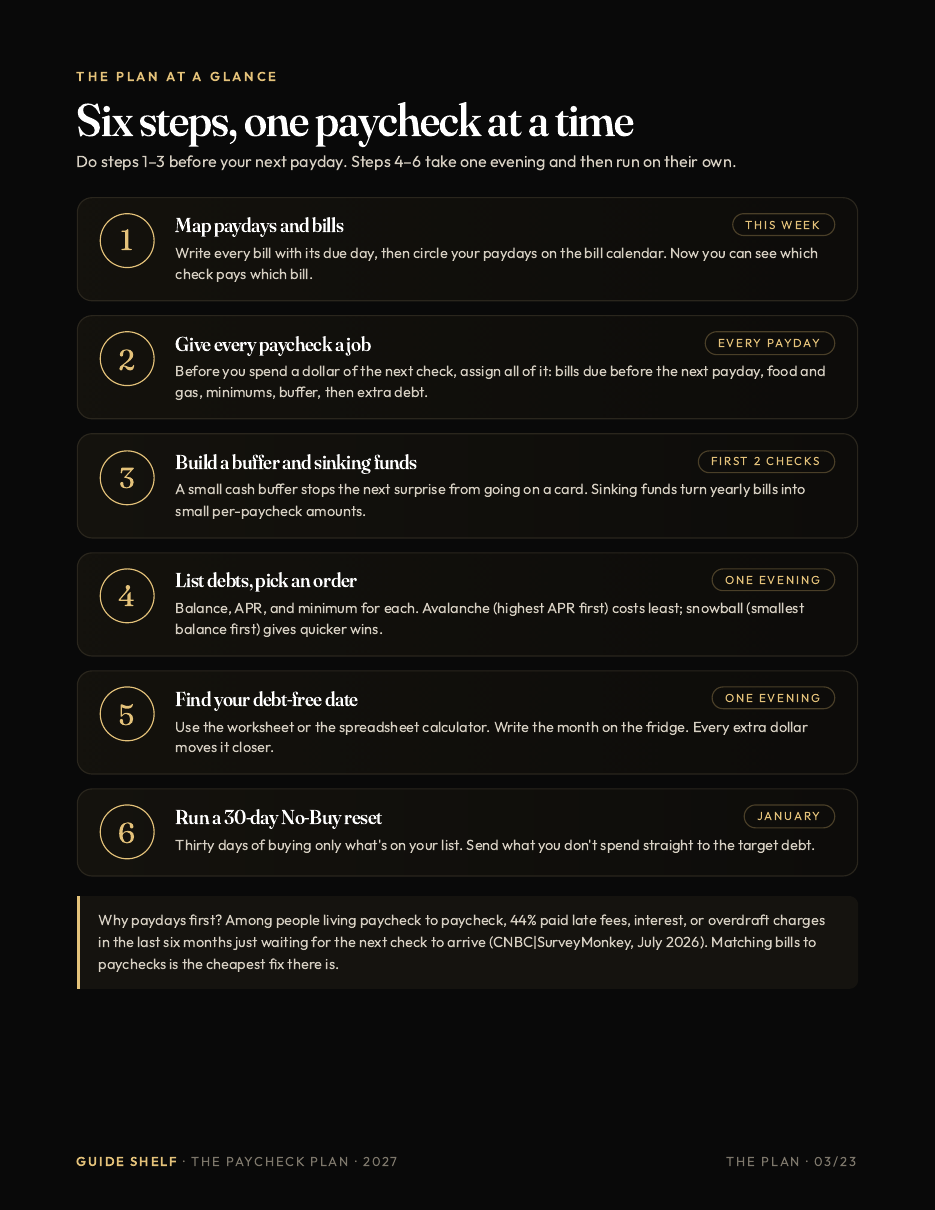
1. Put your paydays and bills on one calendar

List every bill with its due day and circle your paydays. Each bill belongs to the paycheck that arrives before it's due. If a big bill always lands right before payday, ask the company to move the due date.

2. Give every dollar of each paycheck a job

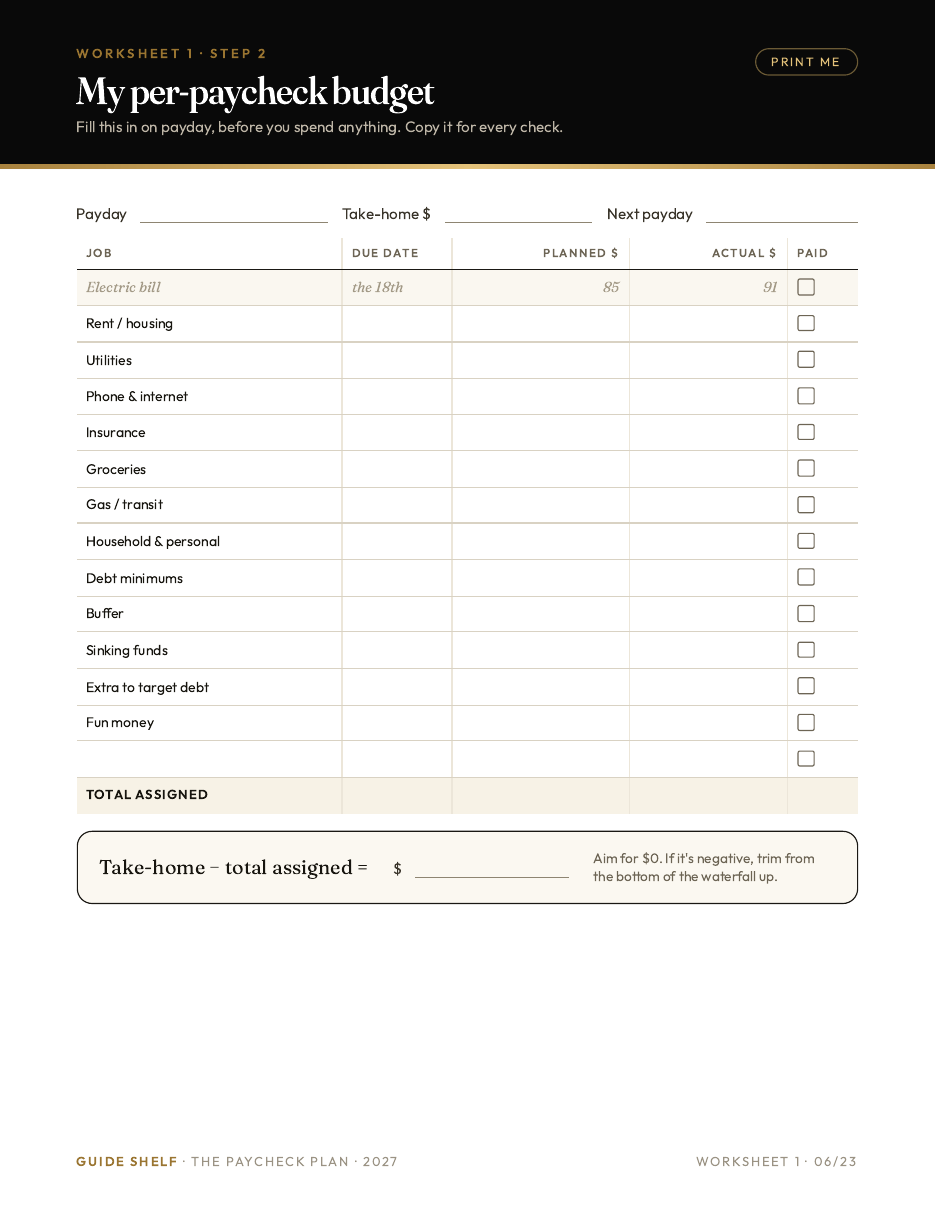
Take-home paycheck − (bills due before next payday + food and gas + minimums + buffer + sinking funds + extra debt + fun) = $0

Fill the jobs in that order. If money runs out, you cut from the bottom, never the rent. Example: an $1,800 biweekly check can cover its share of bills and still send $150 extra to debt (our example numbers; the guide shows $1,200 and $2,500 too).

3. Build a small buffer and sinking funds

A cushion in checking stops timing gaps from turning into fees. Sinking funds split yearly costs (holidays, car registration) into small per-paycheck amounts.

4. List your debts and pick avalanche or snowball

Avalanche sends extra money to the highest APR first and costs less. Snowball clears the smallest balance first for quicker wins. Card APRs averaged 22.15% on accounts charged interest in Q2 2026 (Federal Reserve G.19).

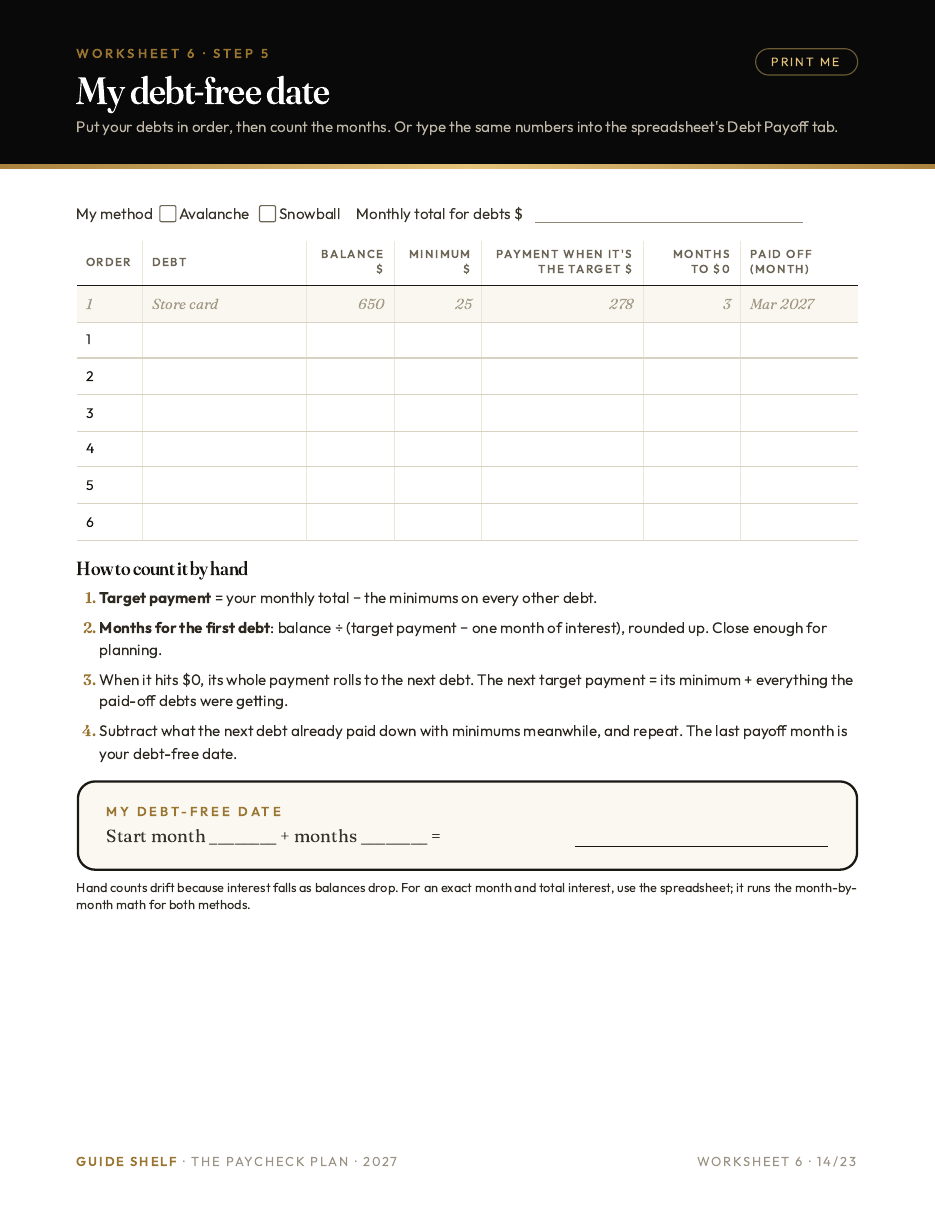
5. Find your debt-free date

Holiday debt averaged $1,223 for the 37% who took some on last season (LendingTree). At 22.15%, $100 a month clears it in about 14 months; $200 a month in about 7 (our math). In our four-debt example ($7,373, $500 a month from January 2027), both methods finish in June 2028, and avalanche saves about $182 in interest.

6. Run a 30-day No-Buy reset

For 30 days, buy only what's on your "still buying" list, and send what you don't spend to your target debt each payday. Searches for "No Buy January" hit a five-year high in January 2026 (The Wall Street Journal).

General education, not financial, legal, tax, or credit advice. We don't sell or recommend any card, loan, or debt relief company. Paycheck examples, payoff months, interest, and debt-free dates are our math (monthly compounding, no new charges). Facts checked October 26, 2026.
Look inside

Guide page: the six-step Paycheck Plan, one paycheck at a time
The six-step plan
Printable worksheet: per-paycheck budget with due dates, planned and actual amounts
Worksheet 1 · Per-paycheck budget
Printable worksheet: debt-free date, with payoff order and months to zero
Worksheet 6 · My debt-free date

What's inside

  • The paycheck waterfall: seven jobs for every check, in order, so rent never lands on the wrong week
  • Worked examples: every dollar of $1,200, $1,800, and $2,500 biweekly paychecks assigned
  • Worksheets 1–3 · Per-paycheck budget, bill list, bill calendar: which paycheck pays which bill
  • Third paychecks and uneven income: the 2027 three-paycheck months and how to use them
  • Worksheet 4 · Sinking funds: yearly costs turned into per-paycheck amounts
  • Holiday debt math: what $1,223 at 22.15% costs at $50, $100, $150, and $200 a month
  • Avalanche vs snowball, with a debt-free date: a four-debt example, plus Worksheets 5–7: debts, debt-free date, 2027 tracker
  • The 30-day No-Buy reset: rules, Worksheet 8 (my No-Buy list), and Worksheet 9 (the daily checklist)
  • Payday check-in, checklists, and a one-page summary: Nov 2026 through Dec 2027
  • The spreadsheet (.xlsx): per-paycheck budget, bill calendar, sinking funds, and a debt payoff calculator that shows months, total interest, and your debt-free date for both methods
Printable PDF (23 pages) + Excel / Google Sheets spreadsheet
$20$9.99
Get instant access — $9.99

Pay securely with Stripe and download right away. Your receipt is emailed to you.

Add-on and bundle

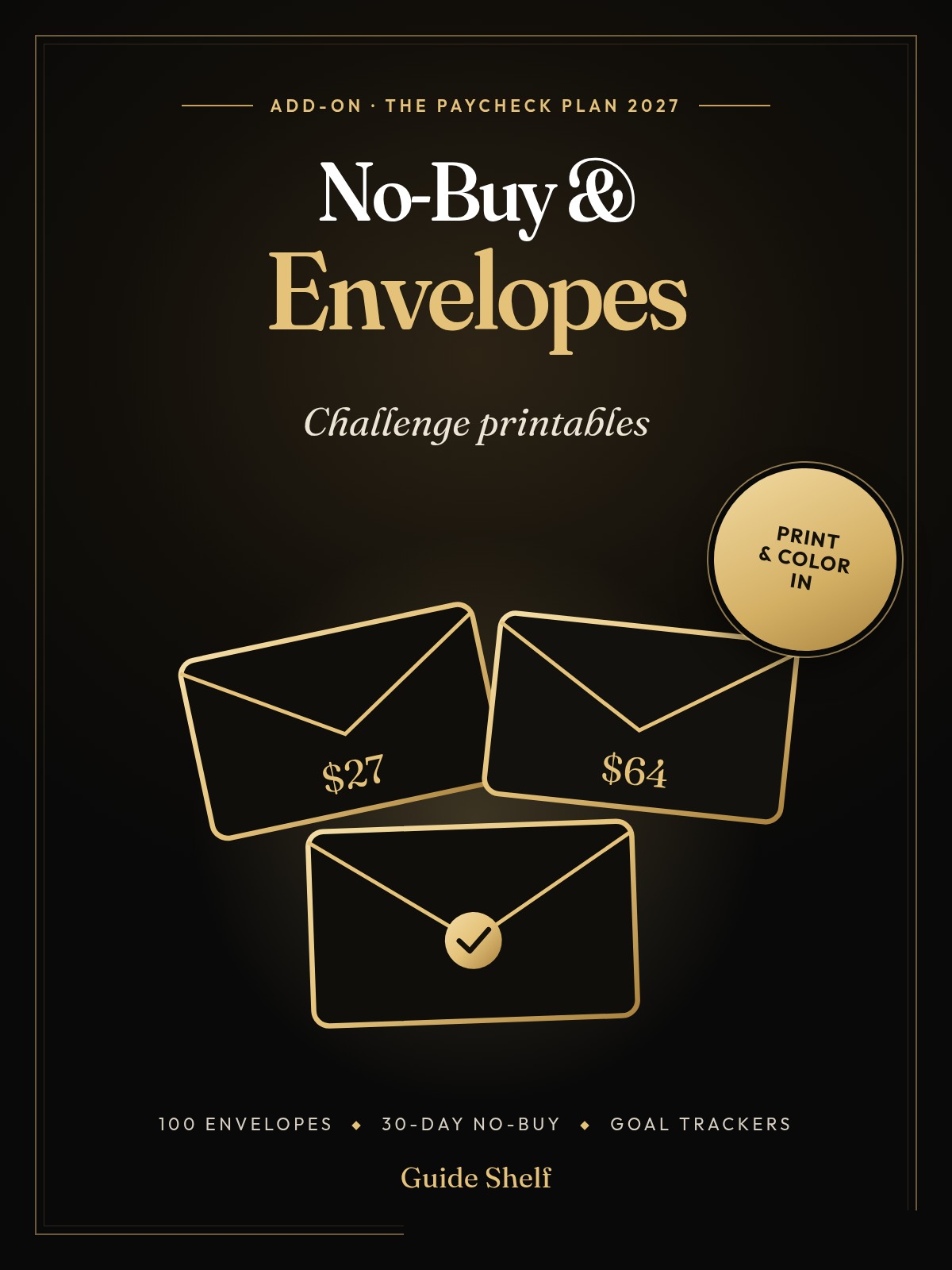
Cover of the No-Buy and Envelope Challenge Printables add-on Add-on · 8-page printable PDF

No-Buy & Envelope Challenge Printables

100-envelope chart ($5,050 if you finish), a 50-envelope version ($1,275), a 26-paycheck ladder ($1,755), a 30-day No-Buy calendar, a temptation log, sinking-fund envelope trackers, and goal thermometers. Totals are our math.

$4.99
Get instant access — $4.99
The Paycheck Plan 2027 with the credit card payoff and holiday budget guides Bundle · 3 guides + spreadsheet

The $19.99 Debt-Free Bundle

The Paycheck Plan 2027 (with the spreadsheet), How to Pay Off Credit Card Debt in 2027, and How to Make a Holiday Budget. Save $9.98 vs buying the three at $9.99 each.

$29.97$19.99
Get the bundle — $19.99

Instant download after checkout. Buying the Paycheck Plan on its own? You can add the printables for $4.99 right on the checkout page.

FAQ

How do I budget when I live paycheck to paycheck?

Budget by paycheck instead of by month. List your bills by due date, match each one to the paycheck that arrives before it, then give every remaining dollar a job in order: food and gas until the next payday, minimum payments, a small buffer, sinking funds, extra debt payments, and a little fun money.

What is a paycheck budget?

A plan for one paycheck at a time. Instead of one monthly budget, you plan each check on payday so bills due before the next payday are always covered. Take-home pay minus everything you assign should equal zero.

Avalanche or snowball: which pays off debt faster?

Avalanche (highest APR first) costs the least interest. Snowball (smallest balance first) gives quicker wins. In our example of four debts totaling $7,373 with $500 a month, both finished in 18 months; avalanche saved about $182 in interest.

How do I find my debt-free date?

List each debt's balance, APR, and minimum, choose a fixed monthly total, and count the months as each paid-off payment rolls to the next debt. The included spreadsheet does this month by month and shows the date for both methods.

How long will it take to pay off holiday debt?

It depends on the payment. Using LendingTree's $1,223 average and a 22.15% APR, $100 a month takes about 14 months and about $176 in interest; $200 a month takes about 7 months and about $87 (our math, no new charges).

What is a No-Buy challenge?

A set period, often 30 days, when you buy only what is on a pre-written "still buying" list, such as rent, bills, groceries, and medicine. The guide includes the rules, a list worksheet, and a daily checklist; send what you don't spend to debt.

Does the spreadsheet work in Google Sheets?

Yes. It is a standard .xlsx file with plain formulas and no macros. Open it in Excel, or upload it to Google Drive and open it with Google Sheets. Yellow cells are inputs; everything else calculates.

What's in the printable guide?

A 23-page PDF: the six-step plan, the paycheck waterfall with worked examples, a bill calendar, sinking funds, holiday debt math, avalanche vs snowball, a debt-free date worksheet, a 2027 tracker, a 30-day No-Buy reset with a daily checklist, a payday check-in, checklists, a one-page summary, and sources.

Is this financial advice?

No. It is general education with worksheets and a calculator. We do not recommend any specific card, loan, bank, or company.